I am a writer who writes because I have something to say. Is what I have to say important? I guess I think so because otherwise my books would be different. However, I am not arrogant enough to think what I say is important. I do believe my subject matter is important.
First, I hope people enjoy No More Ugly Girls. I hope people to take the time to fall in love with Auburn as I have.
So here is my pitch for No More Ugly Girls to be your next book club selection.
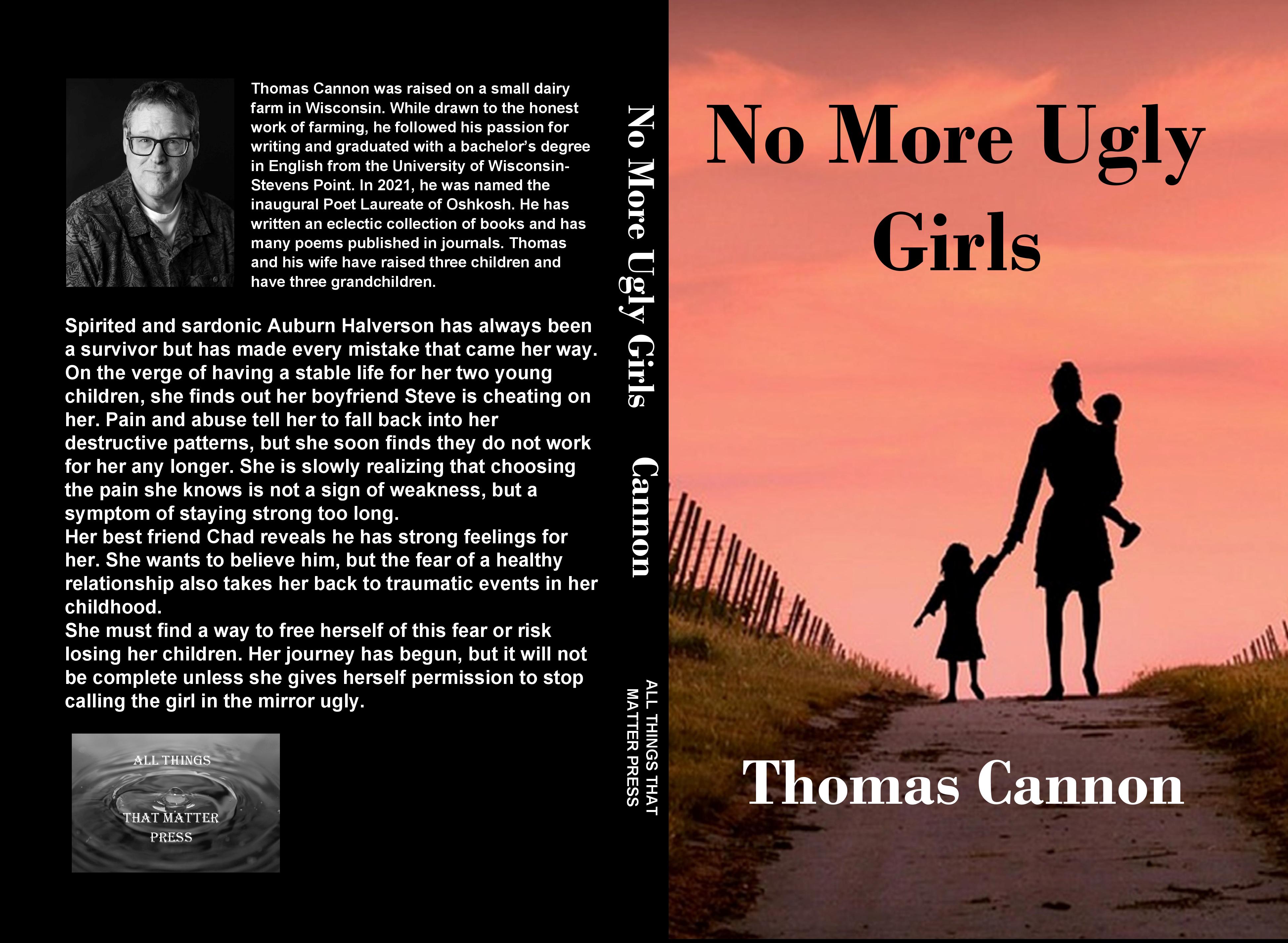
The Book: No More Ugly Girls
Auburn Halverson spent her teen years telling herself the lie that she is ugly. Now a mother of two, she discovers her boyfriend is leaving her for another woman and falls back into destructive patterns. However, she realizes she can no longer find comfort in sticking with the familiar pain. Reluctantly, she sets off on a journey to find her true beauty.
The novel began as a study of the inner strength in women. This strength allows them to keep trauma secret while dealing with life.
We have scripts written in our subconscious by what has happened to us. They are written for efficiency and not happiness, so harmful experiences write harmful scripts. Everyone struggles because we believe these scripts as truths. However, women have the extra burden of how our society judges and objectifies women.
Book Club Kit:
- Discussion guide
- Opportunity for author visit (in person or via zoom)
- Email & messaging access to author
- Bookmarks, pens, and signed books.
Contact Info:
Thomas Cannon
Email: Tcbcannon@gmail.com
Website: www.thomascannonauthor.com
Facebook, Instagram, and Youtube: @Thomascannonauthor
The author:
In August 2021, Thomas Cannon was selected as the inaugural Poet Laureate of Oshkosh, WI. He is the author of the books including No More Ugly Girls, The Tao of Apathy and Shattered. His poems and short stories have been published in various journals such as Midwestern Gothic and Corvus Review. He lives in Oshkosh, Wisconsin with his wife and has been a special education teacher for over twenty-six years.
No More Ugly Girls and Rewriting Our Script
Spirited and sardonic Auburn Halverson never met a mistake that she didn’t then make. But she’s determined to secure a stable life for her two daughters. Her resolve shatters when she uncovers her boyfriend’s infidelity, threatening to send her straight back to her old ways.
What pulls her into old patterns? Broken trust and trauma. Like many people that have experienced emotional pain, she forges forward without escaping it.
No More Ugly Girls began as a way to honor that inner strength survivors have to keep moving while carrying their pain hidden away.
Our society tells abused girls they must hide their pain. Then it tells them secrets make them ugly.
It is only through sheer strength of character that they carry on with life.
You may be asking yourself why is Tom the person to write this book? The answer is only because I did. I wrote what was important to me. It was not my intent to tell a story that was not mine to tell. I have not experienced trauma. I have simply cared about people that did.
Occasionally, I consider that this whole book may just be a big rationalization as to why women that I loved rejected me. And that I am just trying to make the case that it wasn’t my personality.
Let me reassure you. I spent years making the case that it was me. I haven’t ruled it out.
However, I have worked with troubled people for many years. People that harm themselves. People that have overdosed and go back to doing drugs. Trafficked girls that will go back to being trafficked.
I wanted to explore why people make choices that others can’t understand. And this is what I came up with. We all begin on one path. However, for people with trauma, someone has spun them around onto a different path and given them a weight they must carry. It is not the path they chose, but they still get judged for going down a more difficult path. Like everyone, they only know to keep moving.
There are metaphors of what it is like to live with trauma. I am going to adapt them to extend my own metaphor of that path. Just like everyone, a person with adverse experiences tries to pack tools they need for the path of life. But they never take out the heavy rock that is trauma out of their backpack. And maybe the rock takes up so much space they leave out some of the things they need. So, it is no wonder they stumble. Why they have a lot of trouble making it to the destination of selfactualization. This word simply means becoming the best version of yourself. They are amazing people. People we love. But they have trouble loving themselves.
Which is where the title comes from. When Auburn looks in the mirror, she sees ugliness. So many girls and women do. We need to find a way for them to stop seeing themselves as ugly.
The real title of my book should be no more ugly men. I say this because men are almost always the abusers, and I want to make it clear that the problem is not the people that see themselves as ugly.
I want to be part of the conversation of people not hurting other people. But with this book, I want to tell a story about a person judging themselves for other people’s sins. This happens because we cannot understand how someone can harm us. Especially children. They are only aware of their own minds, so if somebody does something bad to them, they must come to the conclusion there is something wrong with themselves.
Here is a short selection of Auburn talking to her mom Betty about her dad running out on them. Cody is her nephew that lives with Betty and Emma is Auburn’s 4-year-old.
Auburn found her mom standing on a stepladder, struggling to pull a box out of the attic opening. Cody was running circles under her.
“Cody, Emma is downstairs watching cartoons. Mom, let me help you with that.”
Betty carried the box down the ladder by herself and dropped it on the floor. “More of your dad’s crap. I got boxes of his clothes. His hunting boots. This has some of his family’s pictures in it and his army uniform. I suppose I better drop it off over by him.”
Auburn couldn’t imagine going over to his house. She could no more imagine a conversation with him than she could with George Washington. “Didn’t he take anything with him? When he left?”
“He took enough. He took the checkbook, the car, and for some reason, the toaster.”
“You didn’t let him come get his stuff?”
Betty picked the box up. “I never said he couldn’t.” She lumbered down the stairs with the box. “I’ll probably kick this around for months before I take it over to him,” she said with Auburn following behind her. “There’s always a chance I could get lucky, and he’d die.” She laughed, turning around at the base of the steps to see Auburn’s reaction to her joke.
Auburn looked at her. “It’s weird that he left so much stuff here. Like he just grabbed some stuff and left in a hurry.”
Betty put the box by the back door in the kitchen. “I think he probably had a dinner date. BLTs I figure with him taking the toaster. Why are you going on about this? If you’re thinking I kicked your dad out, you’re wrong. I didn’t volunteer to raise two kids by myself.”
“I’m not.” What Auburn was thinking about was how annoying she had been as a child. Her mom always told her that she had been a clingy child. And she remembered how desperate she had felt when her dad got irritated with her. Many times, he had picked her up and with clenched teeth, set her down in the next room. She saw the same feeling in Emma’s eyes when Steve yelled at her.
A few moments later, Auburn asked, “Did Dad care about you when you got married?”
“That’s not even worth thinking about.”
“I think he did. I know he did. You have all his things still in your house. Why would a guy leave his hunting stuff unless he got totally fed up and something drove him out?”
Betty looked up at her. Her lower lip quivered with anger. “I didn’t do nothing to drive your dad out.”
“I know. I did.” Her words that she kept secret since she was a kid now came out as if she was having a conversation about her weekend. But that was how it had been going lately. She had been telling things she knew should be kept secret and thinking thoughts that should be kept hidden. “I knew dad worked nights, but I couldn’t keep quiet during the day. I would forget and bang around the house. And I was always clinging to you. I wasn’t much of a daughter to him.”
Her mother squinted through her outdated, tinted glasses, her face looking old. “I held onto his stuff out of spite, all right? He didn’t want to face me, so he wanted to come pick it up when I wasn’t here, and I wouldn’t let him.”
Auburn picked up another cup. What does that mean?
“So, let’s get rid of this stuff and be done with him.”
As her mom packed up cooking pans she no longer used, Auburn thought of how she could take his bow and his hunting clothes over to him and see if her mom was telling the truth. His stuff would be a good excuse. She imagined him coming to the door, and mumbling hello. His house would smell like cigarettes and cooking grease. At first, he would be hesitant to invite her in. Once he let her inside, he would sit down in the recliner he watched ballgames and drank his Pabst in. She would sit down on his couch and nothing good would happen next.
I am not sure of my original purpose for writing this scene, but I think Auburn blaming herself came as a revelation. Because it was not until after I finished this book, that I learned that most of how we handle life is in our subconscious minds. Our brains want to be super-efficient, so it writes scripts for us. We don’t know we are reading from them, but we are. So where does this script come from? The relationships around us and our culture. Our interpretation of events that happen to us. Bad experiences write bad scripts. As a little girl, Auburn can only see her dad abandoning her as her fault. So, whenever she is rejected, her script is that she is the problem.
For whatever reason my script when there is conflict is to shut down. To avoid conflict. That script works because a crisis is avoided. So, my brains says, let’s do that all the time then. However, that is not necessarily the right way to handle things.
Here is a few lines from the book.
The sweat dampening her hair spurred her on. She felt cleansed inside and she didn’t quite trust that. As a kid she loved to run and how it made her feel free, but her thing as a teenager, what she had called her “talent,” had been to sit on the couch smoking a cigarette and make fun of people that exercised. Actually, she mostly made fun of herself for not doing it. She could not garner attention with physical feats, but she did with making dumb choices.
Research shows us that girls slowly lose their enthusiasm and self-assuredness as they go into their teen years. Throughout the story, Betty. Auburn’s mom, repeats, “You were such a sweet kid, why can’t you be like that again. For Auburn, an adverse childhood taught her that she was not good enough to be liked. That she caused bad things. Yet like anyone, she wanted attention, and her childhood taught her she could only get it by negative things.
Her father leaving wrote a script that she was a bad daughter. After that she was looking for evidence to back up this belief. We find what we are looking for. We find things that fit our scripts.
We aren’t even aware of these patterns or why we do things. Luckily, there are ways to discover our hidden thoughts, but more on that later.
To heal, the first thing we must establish is that change begins with our thoughts. Thoughts become habits and habits are what shapes our path in life.
As I was mining my book to figure out how to market it and to see if I had something to say, I notice that as things get more tense, Auburn is often angry at her kids and ready to get into an argument with her best friend Chad. To me, she is a good mom. She loves her children.
Here’s an example where she comes to collect her children Emma and Jackie from her mom’s house. Cody is her nephew and Socks is her cat.
Auburn walked into her mom’s dining room to find Cody and Emma having made a fort with the cushions off the couch, the chairs from the dining room, and blankets off the bed upstairs.
“Emma, pick that mess up right now,” Auburn said. She didn’t want her mom pissed off.
“No.”
Auburn ran over to her and grabbed her arm. “Don’t tell me no. You’re very naughty. Clean this up.”
Cody snatched at Auburn’s arm. “Her not naughty. Leave her alone.”
“No,” Emma repeated, which made Auburn’s hand fly at Emma’s butt. She couldn’t handle both of them ganging up on her.
Her violent moment spooked Socks who darted from the fort and sprinted upstairs.
“For Christ sakes, Socks. You’re going to trip me,” Betty yelled as she came down the steps with Jackie. “What’s the big deal, here, Auburn? Let them be.”
“Don’t ask me what the big deal is. You’re the one that goes psycho over a mess.” She let Emma twist away from her grip and fall to the ground. Then she held out her arms for Jackie, but Jackie put her head on grandma’s shoulder.
“Go ahead and make your own fort then, if it’ll make you happy,” her mother quipped.
This is not an event for mother of the year. However, I think that this shows something important. Something about stress. Our amygdala is our survival control. It tells us not to think but to protect ourselves by either running away, freezing, or fighting. If we are just reacting, we can’t use our values. If we remain stressed out, the amygdala gets stuck on.
Children that have adverse childhood experiences have changes in their brain chemistry and brain structure. It affects the regulation of dopamine and serotonin forever. This includes their memory and their stressed response centers.
Now combine that with our brain’s desire to keep doing what it knows. Our brain would rather stick with predictable pain over unpredictable change.
It’s engrained in us. We have neural pathways in our brains. The more we do things and repeat a thought pattern, the more these pathways become a freeway. There’s a saying that Neurons that fire together wire together. However, it’s difficult to forge a new road. It takes time to make a new way strong enough we take it automatically.
To top it all off we have our critical inner voice. We have that voice that nags at us. It comes from internalizing negative attitudes of the caregivers around us as children. So we have a voice in our head saying you are not worthy to be happy. It goes along with the track record of surviving with unhappiness.
Auburn’s father was an alcoholic and abandoned Betty with two children. Betty was experiencing her own stress and was not at her best. She probably often was critical. Actually, I’m the author, so I say she was. The story doesn’t give advice on this, but I do. Don’t be that way with children. Be careful not to say things like, Quiet down and stop being annoying. Don’t be so foolish Careless words became Auburn’s critical voice. As an adult, she has internalized her mother’s words.
Here is a snippet of Auburn and her mom. The night before, Auburn’s best friend, Chad, told her that he had feelings for her. Steve has abandoned her, and Chad only comforted her. Here we can see why Auburn can’t trust that.
“How’d it go last night?” her mom asked from the kitchen where she was putting Jackie in the high chair. “Did you get things worked out?”
Auburn looked at the fort, still incensed that these kids were getting to do something she had never been allowed to do. She walked toward the kitchen. “Things look good.”
“Well, come in and tell me.” Auburn came to the door. Betty warmed some rice cereal for Jackie in the microwave and got out the sugar. “I think that it’s really important that you stick with Steve. He’ll come around.”
“She’ll eat cereal without sugar.”
“I always liked him. The way he paid attention to Emma was all I needed.” When the microwave dinged, Betty stirred the cereal up and spooned sugar into it.
“Yeah, well, then you should be happy because we are working things out.” I better give her some credit, so she’ll watch the girls again. Last night had made her feel good, but in the harsh light of Betty, it was one of her dumb acts. Not that I’ll ask her until Steve and I are back together.
In spite of her own thoughts, a decision on how she felt last night dinged in her head. She had felt safe. Chad hadn’t pushed and only listened. However, if Chad kept listening, he’d get to know her and once he did, he would be disappointed. Auburn knew that Betty figured the only smart thing she ever did was get a man with some security. Auburn had been proud of this, her one accomplishment, but now it wasn’t an accomplishment, but her only option. “It was great that you watched the girls for us. It really helped and I am going to do whatever it takes to make things work with Steve.”
“Well, don’t get pregnant again.”
“You think I did that to get him in the first place?”
“I’m just sayin’ don’t do something stupid.”
Auburn began gathering up some of Jackie’s things in the kitchen. “Don’t you mean, quit doing whatever you’re doing that drove him away?” She carried the washed bottles out of the kitchen and dumped them in the diaper bag. She looked for other things of the girls to gather. Her mom was badgering her, her sister was picking on her, and her only bright spot in her life was the guy that was giving her attention. Auburn felt sixteen again. It made her question the realness of Chad’s attention. Every time, that bright spot of new love had faded before she could warm herself in it.
Her mom had most things packed. She took the stuff out to the car and stomped back into the kitchen.
“Auburn, don’t get all sensitive.” Her mother wiped Jackie’s face off with a washcloth. Jackie had her tongue out and when Grandma moved the cloth over her mouth, she made a sound. “You know how you are.” Auburn yanked the metal tray off and pulled Jackie out.
Auburn is trying to find her way. She sees that the right path is forward with Chad, somebody that cares for her. That path though is uphill, and she is still carrying that heavy rock that is trauma. Her inner voice is telling her she can’t put it down. The path with Steve is downhill and he will never ask her what she is carrying.
And I think that is a huge truth. Until you do reveal a secret, you feel you must hide it. Trauma causes shame. It’s easier to believe your critical inner voice than says you are an ugly person over comprehending that someone you loved betrayed you.
So, I’m going to read another short section. I think it shows that bad choices can feel like the only path.
When she went back into the house, Steve was sitting on the couch reading The Cat in the Hat to Emma snuggled in the hollow of his arm. “She said she couldn’t sleep,” Steve said.
“And you fell for that? It’s a scam. She’ll have you reading all night.”
Steve motioned to her. “Come sit with us.” He patted the cushion on the other side of Emma. “Please?”
Auburn slid herself under Emma so that the child was on her lap with her legs on Steve’s. “But this is special, isn’t it? Having Daddy read a story.”
“Uh-huh.” Emma stared at the book, waiting for its page to turn, her hand on Steve’s arm as he held up the book.
“You better enjoy it while you can.”
“Now where were we?” Steve said, tilting the book back up. Auburn tucked Emma’s hair out of her face while she felt Steve caress the back of her own head.
Both Emma and Auburn clung to him as he read then, as if he was a lifeboat in a deep ocean.
After they tucked Emma back into bed, Steve got ready to go out for a run. Auburn watched him change his clothes and lace up his running shoes. She told him, “Her schedule is all messed up ‘cause she slept at Grandma’s the last two nights.”
“That will happen.”
She followed him downstairs to the living room where he did some stretches on the floor.
“Okay,” he said. “I’ll be back in a little while.” She nodded and wondered if he would make his run to Cindy’s apartment and then back. Then she went upstairs and put on her sports bra and her old pullover Janesville Jaguar’s sweatshirt and gray sweatpants.
While lacing her shoes, the phone rang, and she let it go unanswered. It would be Chad. The caller waited until the answering machine picked up but didn’t leave a message. After the phone fell silent, she turned the ringer off.
She dragged her jump rope down the backstairs and stood under the bright security light. She felt tired and her arms felt too heavy to lift the jump rope. But she got into position and spun the rope into motion. Chnnnt. Chnnnt.
Chnnnt. Her feet jumped and she kept going.
Each time the rope came over her head and headed toward her feet, she thought she would give up. She pumped and imagined having a conversation with Steve when he got home. I’ve been so lazy since middle school. I thought I’d have a heart attack. But if I’m going to be dating again, I have to get serious.” She snagged her foot and for a moment she did stop. She listened to her heavy breathing. Her mom’s voice intruded the conversation. It could be the truth, Steve. But the truth is she thinks that the more attractive she becomes, the harder it will be for you to leave her.
She began again. Faster. Chnt. Chnt. Chnt. Chnt. Chnt. She made herself stay in constant motion until she tripped up.
Now her breathing was hard. Yet as she began for the third time, her warm body made her feel energetic. Her attempts in the last few weeks at jump roping had felt like a chore. She had put the time in because Steve wanted her to lose weight.
She continued her imagined conversation with Steve. This is better than drugs. No wonder why you wanted
me to start exercising.
Still drugs are easier. Ha, ha. And you can have sex while doing them. You don’t do either anymore was the response she imagined from Steve.
So, at this point, Auburn is reading the same script life has written for her. However, Auburn is doing the right things. She is exercising. Clearing her mind with endorphins. She has replaced the negative coping skill of doing drugs with a positive coping skill.
Not to get too preachy, though I already am. Holistic things like meditation is a way to tap into the subconscious and find out those hidden thoughts and patterns.
Therapy does that. Auburn should be seeing a therapist.
The thing I want people to explore is writing their story. Whether it’s a book, a poem, or a journal, or a stream of consciousness on a napkin, writing accesses your subconscious. When we think we are going in circles. When we write, we slowly go in a direction. Our brain starts gathering thoughts and it doesn’t matter where they are. It just goes this thought goes with this thought. Until you have an epiphany or at least think about things in a new way.
To really extend my heavy rock analogy, the brain picks away pieces of that trauma in your backpack until its light enough and small enough you can put it down.
I’ve had my share of hard times. But I am blessed not to have experienced trauma. I am still in this book. Perhaps I am sharing my patterns of wrong behaviors and wrong thinking more than anyone else’s.
My goal with writing this book was to create a female character that made wrong choice after wrong choice. Because I believe this is not weakness as too many people think. But of incredible strength. Of staying strong too long.
Hopefully men and women that carry trauma with them can identify that strength within them.
And use it to get beyond their trauma scripts.
After this book was published, I asked myself, “Am I the one to tell this story?” Perhaps a question I should have asked earlier in the process. All I know is that I want to tell stories, and this is the one I had to tell. I want to record the human experience. To honor other’s struggles.
Hopefully, I still have written something that improves the world we live in.
Proposal for book Reading
Title: No More Ugly Girls -Rewriting Your Life’s Script.
Speaker: Thomas Cannon Duration: 1 hour Description:
Author Thomas Cannon’s book No More Ugly Girls is the story of Auburn Halverson. She’s never met a mistake that she didn’t then make. Now with two young daughters, she’s determined to have a stable life. Yet she is tempted to fall back into her old patterns when confronted with her boyfriend’s infidelity.
The novel began as an exploration of the inner strength he saw in women that allows them to carry the weight of trauma. Often in secret.
For everyone. we have scripts written in our subconscious by what has happened to us. Written to be efficient, these patterns of thoughts and behaviors are what our subconscious deems to have worked. Harmful experiences write harmful scripts. Everyone struggles because we believe them.
However, women have the extra burden of the lies and judgement of our culture.
Mr. Cannon will use some readings from his book as a jumping off point to explore what these lies are and how we can rewrite the scripts of our lives.
Join author Thomas Cannon for a special event exploring the themes of his novel, No More Ugly Girls. Cannon’s book tells the story of Auburn Halverson, a mother determined to create a stable life for her daughters, even as she grapples with her past and a recent betrayal.
Drawing from the novel’s exploration of women’s inner strength and the hidden weight of trauma, Cannon will use readings from the book to discuss the “scripts” our subconscious writes based on our experiences. He will delve into how harmful experiences create damaging patterns of thought and behavior, especially for women who face the additional burden of cultural lies and judgment. The event will offer insights into identifying these lies and rewriting the scripts of our lives.
The proposed event is a one-hour program structured as follows:
- A talk with readings (30 minutes): Mr. Cannon will read a selection from No More Ugly Girls, offering a powerful live experience of his writing.
- Author Q&A (15 minutes): A moderated or open Q&A session will allow patrons to ask questions about his writing process, inspirations, and specific works.
Book Signing & Meet-and-Greet (15 minutes): Following the Q&A, Mr. Cannon will sign books and interact with patrons.
Embraced
She embraced good living like a rainstorm.
dropped out of the surge to wreck youth
like a wave lashing a sandcastle
alcohol and drugs had been a day at the beach that left her raw and burned.
she only drank now
and then
to do the rain dance
with hands out
She exercised, raked the yard and went to church anytime he did.
The rain turned cold the week after the baby was born.
His attention drizzled the breeze of old boyfriends picked up, tore at her clothes
raised welts on her skin
retreating to the empty house, embraced by her own naked arms she tried to warm herself enough to stop shivering.
as good living dripped off into regretful rivulets
 Thomas Cannon Author